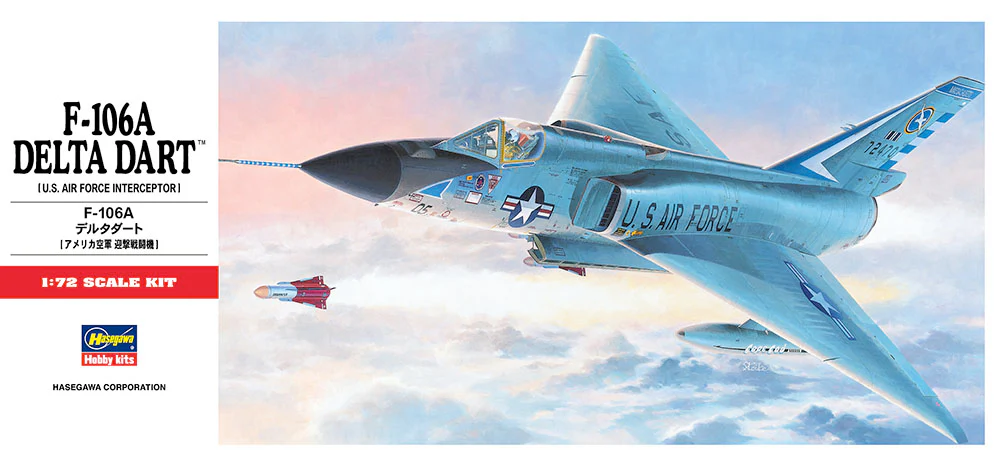
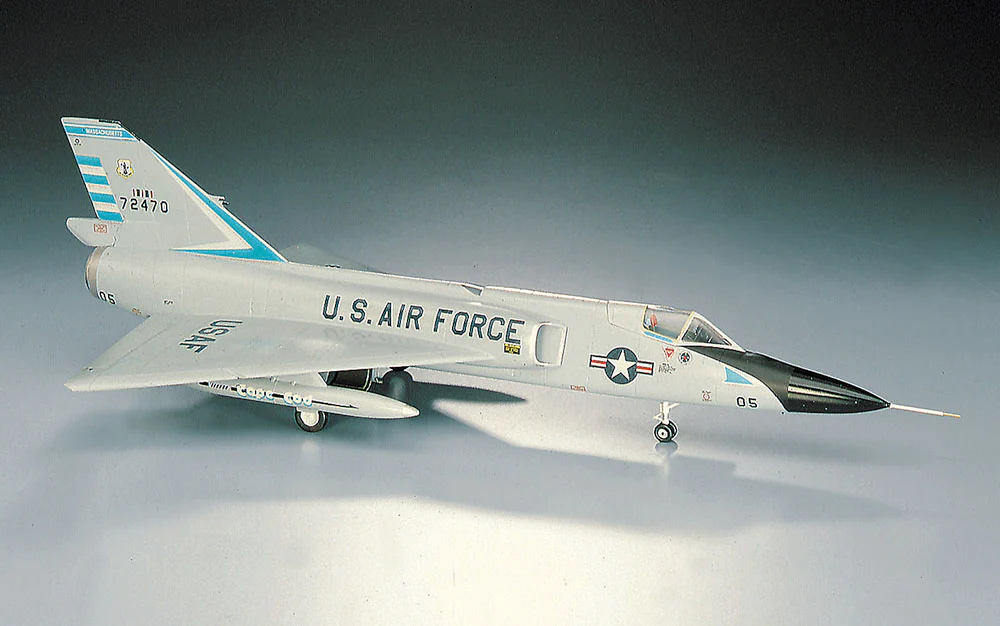
Hasegawa [C11] 1:72 F-106A Delta Dart
The F-106A was developed as an advanced version of the F-102A Delta Dagger, an all-weather interceptor. It was initially called the F-102B. Compared to the J57 engine equipped in the F-102, the F-106, with its J75 engine, achieved a thrust improvement of 50% and evolved into a Mach 2 class interceptor.
The major highlight of the F-106 is its fire control system. Equipped with a digital computer, the Hughes MA-1, which integrated with the semi-automated defense system of the U.S. mainland known as SAGE, the F-106 boasted near-complete automated advanced interception capabilities. Naturally, it was equipped with state-of-the-art radar and navigation equipment, providing it with sophisticated all-weather capabilities.
The primary armament consisted of missiles. Thanks to a missile bay in the central fuselage, it could carry missiles without exposing them, thus not being limited by speed. The equipped missiles included one AIM-2 Genie with a 1.5 KT nuclear warhead and four AIM-4F/G Super Falcons (a mix of infrared homing and semi-active homing). However, the Genie was seldom equipped.
The F-106A was deployed to the United States Air Force's Aerospace Defense Command (ADC) from June 1959 and continued to be used as a main interceptor until the 1980s. Essentially designed to counter the invasion of Soviet large bombers equipped with nuclear missiles, the F-106 wasn't much considered for dogfighting with other fighter aircraft. Therefore, it lacked fixed weaponry. The delta wing's low wing-loading yielded high agility, and some modifications were made to equip the missile bay with the M61 Vulcan cannon for dogfighting. However, the F-106 ended its service without significant combat experiences.
Specifications:
- Crew: 1
- Wingspan: 11.67m
- Length: 21.56m (including pitot tube)
- Height: 6.18m
- Maximum Takeoff Weight: 15,875kg
- Engine: P&W J75-P-17
- Thrust: 7,800kg (military), 11,100kg (with afterburner)
- Maximum Speed: Mach 2.0 to 2.3 at 12,200m
- Fixed Armament: None
- Missiles: AIM-2A/B Genie x1, AIM-4E/F/G Super Falcon x4
- First Flight: December 26, 1956
Product Information
Product Information
Shipping & Returns
Shipping & Returns
Description
The F-106A was developed as an advanced version of the F-102A Delta Dagger, an all-weather interceptor. It was initially called the F-102B. Compared to the J57 engine equipped in the F-102, the F-106, with its J75 engine, achieved a thrust improvement of 50% and evolved into a Mach 2 class interceptor.
The major highlight of the F-106 is its fire control system. Equipped with a digital computer, the Hughes MA-1, which integrated with the semi-automated defense system of the U.S. mainland known as SAGE, the F-106 boasted near-complete automated advanced interception capabilities. Naturally, it was equipped with state-of-the-art radar and navigation equipment, providing it with sophisticated all-weather capabilities.
The primary armament consisted of missiles. Thanks to a missile bay in the central fuselage, it could carry missiles without exposing them, thus not being limited by speed. The equipped missiles included one AIM-2 Genie with a 1.5 KT nuclear warhead and four AIM-4F/G Super Falcons (a mix of infrared homing and semi-active homing). However, the Genie was seldom equipped.
The F-106A was deployed to the United States Air Force's Aerospace Defense Command (ADC) from June 1959 and continued to be used as a main interceptor until the 1980s. Essentially designed to counter the invasion of Soviet large bombers equipped with nuclear missiles, the F-106 wasn't much considered for dogfighting with other fighter aircraft. Therefore, it lacked fixed weaponry. The delta wing's low wing-loading yielded high agility, and some modifications were made to equip the missile bay with the M61 Vulcan cannon for dogfighting. However, the F-106 ended its service without significant combat experiences.
Specifications:
- Crew: 1
- Wingspan: 11.67m
- Length: 21.56m (including pitot tube)
- Height: 6.18m
- Maximum Takeoff Weight: 15,875kg
- Engine: P&W J75-P-17
- Thrust: 7,800kg (military), 11,100kg (with afterburner)
- Maximum Speed: Mach 2.0 to 2.3 at 12,200m
- Fixed Armament: None
- Missiles: AIM-2A/B Genie x1, AIM-4E/F/G Super Falcon x4
- First Flight: December 26, 1956